
ABS 3D Printing Services for Functional & Production Parts
Durable FDM parts for housings, fixtures, prototypes, assemblies, and short-run end-use components.
ABS is a practical engineering thermoplastic when a part needs useful impact resistance, temperature capability, dimensional intent, and a familiar production-plastic feel. Relay reviews geometry, loading, interfaces, quantity, finish, and service conditions before recommending ABS or an alternative.
A workhorse material for real mechanical parts.
ABS is widely used because it balances cost, toughness, stiffness, heat capability, appearance, and post-processing. For FDM parts, the design and print orientation still matter just as much as the polymer name.
Housings & Enclosures
Electronics covers, machine housings, control boxes, guards, and protective shells.
Jigs & Fixtures
Assembly aids, nests, drill guides, positioning tools, and shop-floor fixtures.
Functional Prototypes
Parts intended to test fit, handling, fasteners, impact, assembly, and real-use behavior.
Replacement Components
Low-volume plastic parts where legacy tooling is unavailable, slow, or uneconomical.
Brackets & Mounts
Custom supports, sensor mounts, equipment interfaces, and internal machine components.
Short-Run End-Use Parts
Repeat production where additive manufacturing still beats committing to hard tooling.
Assembly Components
Parts designed around screws, inserts, clips, panels, and multi-component builds.
Product Development Parts
Engineering builds that need something more production-like than a visual model.
ABS is useful because it is balanced—not because it wins every category.
The right choice depends on the actual failure mode. UV exposure, sustained heat, stiffness, flexibility, chemicals, cosmetics, tolerances, impact direction, and production quantity can all push a job toward another material.
ABS vs. ASA
For outdoor exposure, ASA is usually the more natural starting point because of its improved UV and weather resistance. ABS remains attractive for many indoor functional parts and assemblies.
Compare with ASA →ABS vs. Carbon-Fiber Nylon
When stiffness, dimensional rigidity, or more demanding mechanical performance becomes the priority, a reinforced nylon may be worth evaluating despite different cost and moisture considerations.
Compare with carbon-fiber nylon →ABS vs. TPU
If the part must flex, compress, grip, absorb vibration, or behave like rubber, rigid ABS is the wrong tool and TPU becomes the more relevant material family.
Compare with TPU →Send the CAD, quantity, operating environment, load case, and critical interfaces. Relay can quote ABS where it fits and recommend a different route when it does not.
Printed ABS behaves like a manufactured part—not a datasheet coupon.
FDM produces a layered structure, so orientation affects strength, surface finish, support strategy, and dimensional behavior. Large flat areas, sharp transitions, thin walls, unsupported overhangs, and highly constrained tolerances can also change how an ABS part should be built.
For mechanically loaded components, Relay considers layer direction, wall count, local section thickness, fastener loads, inserts, interfaces, and the amount of post-processing that actually adds value.
Loaded Features
Orient and reinforce around the actual load path instead of assuming isotropic plastic behavior.
Threads & Fasteners
Printed threads can work in some cases; inserts, captured nuts, or machined features may make more sense for repeated service.
Tolerances
Critical fits should be identified on the RFQ so they can be handled differently from noncritical geometry.
Surface & Finish
Visible layer texture is normal for FDM. Sanding, painting, machining, and other secondary work can be considered when justified.
ABS rewards controlled printing and sensible geometry.
ABS shrinks as it cools, which is why enclosure temperature, bed adhesion, part orientation, section changes, and overall geometry matter. Warping risk grows on large footprints and geometries that strongly resist shrinkage.
That does not make ABS a prototype-only material. It means reliable production comes from treating the build as a manufacturing process: consistent setup, repeatable slicing, appropriate support strategy, inspection of critical features, and a design that respects the process.
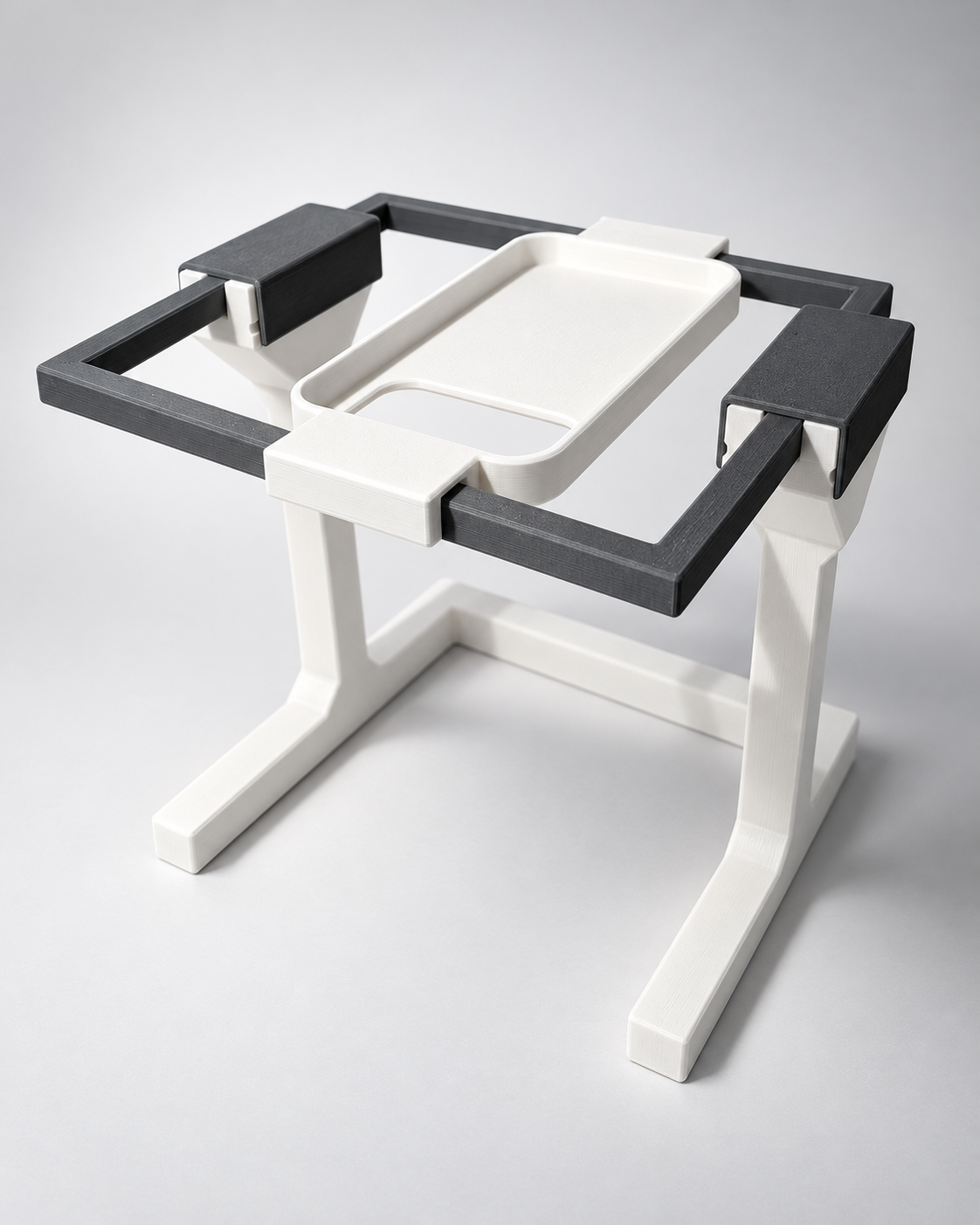
Real Relay example: this ABS parallel phone mount was built to hold a phone square and parallel to a work surface for photographing parts that need to be redrawn in Fusion. It is a practical example of ABS used for custom fixtures, measurement workflows, and shop-built engineering tools.
For repeat quantities, Relay can evaluate whether batch FDM remains the right commercial route or whether another additive or conventional process makes more sense.
ABS is well suited to parts that need work after printing.
Many ABS jobs do not end when the printer stops. Depending on the requirement, parts can be cleaned up, sanded, painted, drilled, reamed, tapped, fitted with threaded inserts, or incorporated into larger assemblies.
The best finishing route depends on what matters: appearance, fit, sealing, repeated assembly, dimensional control, or simply removing support-contact artifacts. Relay can separate cosmetic requests from genuinely functional secondary operations so the quote stays focused on what the part needs.
Threaded Inserts
Useful for serviceable assemblies and repeated screw installation when the geometry supports them.
Machined Features
Selected holes or interfaces can sometimes be finished after printing when tighter local control is needed.
Cosmetic Finishing
Sanding and painting can improve appearance when a raw FDM surface is not appropriate.
Multi-Part Builds
Large or complex geometry may be split intentionally for printing, assembly, access, or serviceability.
Choosing ABS for a real project.
ABS is a material family, and printed properties depend on the grade, machine, geometry, orientation, process settings, and service conditions. These answers are starting points for an RFQ—not substitutes for application-specific review.
Is ABS good for functional 3D printed parts?
Yes. ABS is commonly used for functional prototypes, housings, brackets, fixtures, tools, and some end-use components because it offers a useful balance of toughness, rigidity, heat capability, cost, and finishability.
Is ABS better than PLA?
It depends on the application. PLA is rigid and convenient for many prototypes, while ABS is often preferred when toughness, temperature capability, finishing, or a more production-plastic-like behavior matters. The geometry and load case still determine suitability.
Should I use ABS or ASA outdoors?
ASA is generally the better starting point for prolonged sunlight and weather exposure. ABS can still be appropriate in protected environments, but UV stability is not one of its main advantages.
How heat resistant is 3D printed ABS?
Heat performance varies by ABS grade and test method, and a printed part's usable temperature also depends on load, geometry, orientation, and duration. If temperature is critical, include the expected operating range in the RFQ so the specific material can be checked.
Can ABS be used for low-volume production?
Yes, when the part requirements and economics fit FDM. ABS can be a practical option for repeat functional parts, production aids, replacement components, and short runs without mold tooling.
Can Relay help if I do not know whether ABS is the right material?
Yes. Send the part files and describe the environment, load, quantity, finish, critical dimensions, and target date. Relay can evaluate ABS against other available materials and processes.
Send the CAD and the requirements that actually matter.
Include quantity, operating temperature, loads, indoor or outdoor exposure, chemicals, critical dimensions, fasteners, finish requirements, and target date. Relay can review whether ABS is the right manufacturing route and quote the job accordingly.