
Custom 3D Printed Enclosures & Housings
Built around your board, connectors, mounting points, and real service environment.
Relay manufactures custom FDM enclosures for electronics, sensors, controls, instruments, and equipment when an off-the-shelf box creates more compromises than it solves. Integrate mounting bosses, inserts, vents, cable pass-throughs, connector openings, lids, and assembly features without committing to injection-mold tooling.
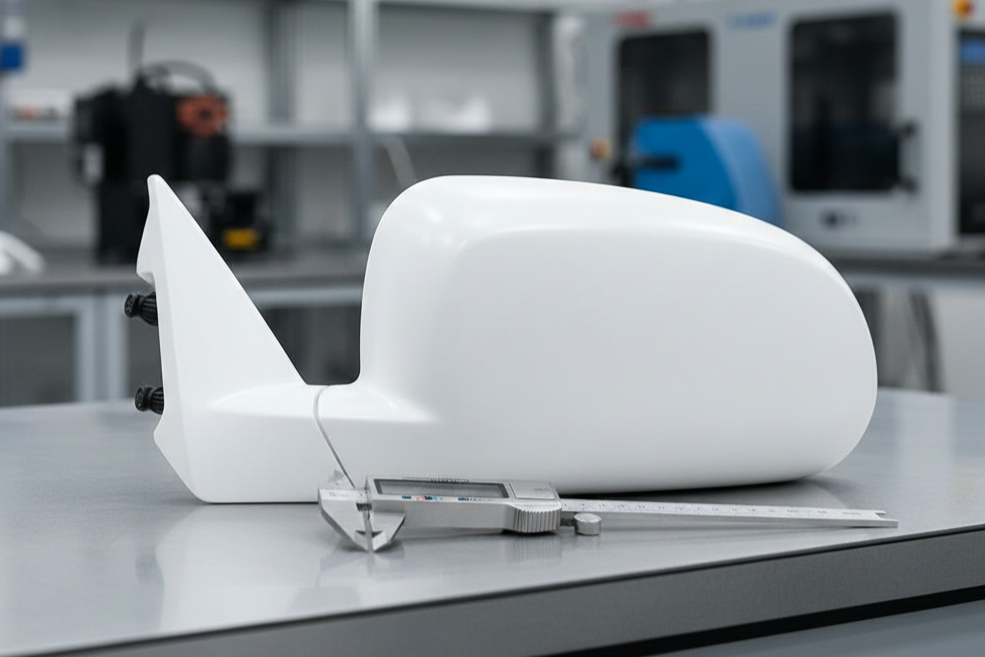
When the box needs to fit the hardware—not the other way around.
Custom printing is strongest when a stock enclosure would require hand drilling, awkward brackets, hot-glued standoffs, or repeated rework every time the electronics change.
PCB Housings
Custom shells built around board outlines, mounting holes, connectors, displays, and internal clearance.
Sensor Enclosures
Protective housings for sensing hardware, remote modules, test equipment, and field devices.
Control Boxes
Enclosures for switches, controls, power electronics, interfaces, and compact industrial systems.
Instrument Cases
Protective housings and bezels for lab, R&D, measurement, and custom equipment.
Connector & Cable Housings
Purpose-built openings, strain-relief features, glands, channels, and cable routing.
Battery & Power Housings
Custom compartments and covers where access, mounting, and serviceability matter.
Machine Covers & Guards
Low-volume protective shells, covers, and access panels around custom equipment.
Prototype Product Shells
Functional housings used to validate fit, assembly, ergonomics, and internal packaging before tooling.
An enclosure is more than six walls and a lid.
The useful engineering is in the interfaces. Relay can review enclosure geometry around the hardware and assembly sequence rather than treating the shell as an isolated print.
Include the board outline, mounting-hole pattern, connector locations, and tallest components with the RFQ. That makes fit review much more useful.
Mounting Bosses
PCB standoffs, internal supports, screw bosses, and local reinforcement around loaded features.
Threaded Inserts
Heat-set inserts or captured hardware for lids and assemblies that need repeated service.
Ports & Cutouts
Connector openings, switches, displays, LEDs, buttons, vents, and cable access where they actually belong.
Lids & Closures
Screwed lids, tabs, snap features, locating geometry, and removable service panels where appropriate.
Choose the enclosure material from the environment outward.
Cosmetics matter, but service conditions usually matter more. Temperature, sunlight, moisture, chemicals, impact, stiffness, and repeated opening all influence the right polymer and build strategy.
PETG
A practical choice for general-purpose functional housings where toughness and moisture resistance matter.
ABS
Useful for many indoor functional housings, assemblies, and parts that benefit from finishing and hardware integration.
Explore ABS →ASA
A stronger starting point for outdoor enclosures and parts exposed to sustained UV and weather.
Explore ASA →The details that decide whether it closes, aligns, and survives.
Enclosures combine thin walls, bosses, fasteners, cutouts, mating edges, and visible faces. FDM orientation changes strength and finish, while long flat walls can flex or distort if they are under-designed.
Relay reviews critical interfaces around how the enclosure is assembled and serviced. The goal is not to make every dimension tight—it is to identify which ones actually control fit and function.
Wall & Rib Strategy
Wall thickness, local ribs, corner radii, and section changes should support stiffness without creating unnecessary mass or warping risk.
Bosses & Fasteners
Boss diameter, edge distance, insert access, screw direction, and repeated service should be considered together.
Fit & Clearance
PCB mounts, lid gaps, connector openings, press features, and mating geometry should be called out as critical where needed.
Visible Faces
Orientation and support placement can be chosen around the surfaces that matter most cosmetically.
Printed plastic solves a lot. It does not magically create an IP-rated product.
FDM enclosures can incorporate thicker walls, gasket grooves, labyrinths, cable glands, drainage, and other sealing features, but a printed enclosure is not automatically watertight or IP-rated. If a tested ingress-protection requirement exists, include it up front so the manufacturing and validation plan can be discussed honestly.
Plastic also does not provide inherent EMI shielding. If electromagnetic shielding is a requirement, that may call for conductive coatings, internal shielding components, or a different enclosure strategy.
Ventilation
Slots, louvers, fans, and natural-convection openings can be integrated around the actual heat sources and component layout.
Gaskets & Seals
Grooves and compression features can be designed in when splash or dust resistance matters, subject to validation.
Outdoor Exposure
UV, weather, temperature cycling, and water exposure should drive material selection and enclosure details.
EMI / RF
Standard printed thermoplastics are electrically insulating and should not be treated as EMI shielding by themselves.
Keep the enclosure flexible while the hardware is still changing.
One of the strongest reasons to 3D print an enclosure is that the digital design can change as the electronics change. Move a connector, resize a board, add a sensor, alter a mounting pattern, then manufacture the next revision without scrapping hard tooling.
Custom enclosure RFQs.
The more clearly the internal hardware and service environment are defined, the more useful the quote and DFM review can be.
Can Relay make an enclosure around my PCB?
Yes. Include the PCB CAD or board outline, mounting-hole locations, connector positions, and component-height constraints where possible. Relay can manufacture an existing enclosure design and discuss practical DFM concerns around the fit.
Can you add threaded inserts?
Yes, where geometry and material support them. Heat-set inserts or captured hardware are often useful for lids and components that need repeated assembly or service.
Can a 3D printed enclosure be waterproof?
A printed enclosure is not automatically waterproof or IP-rated. Sealing features can be incorporated, but tested ingress-protection requirements need an appropriate design and validation plan.
Can I use a printed enclosure for low-volume production?
Yes, when FDM meets the functional, dimensional, cosmetic, and economic requirements. It is especially useful while hardware revisions are still possible or mold tooling is not justified.
What should I upload for an enclosure quote?
Send the enclosure CAD plus, where available, the PCB or internal assembly, quantity, material preference, environment, connector locations, critical dimensions, fastener requirements, finish needs, and target date.
Send the shell, the internals, and the requirements that control fit.
Relay can review the enclosure around the board, connectors, mounting features, hardware, environment, quantity, and service needs before quoting a practical manufacturing route.