
PETG 3D Printing Services for Durable Functional Parts
Tough, moisture-resistant FDM parts for brackets, guards, housings, prototypes, fixtures, and short-run production.
PETG is a practical choice when a part needs more toughness and environmental resistance than a basic prototype material without immediately moving to a higher-temperature engineering polymer. Relay reviews load, interfaces, geometry, quantity, environment, finish, and dimensional requirements before recommending PETG or another material.

Functional parts that need durability without overcomplicating the material choice.
PETG works well across a wide range of practical engineering and shop-floor applications. It is especially useful when impact resistance, moisture exposure, handling, and repeatable function matter more than maximum temperature capability.
Brackets & Mounts
Sensor mounts, equipment brackets, standoffs, supports, and utility hardware.
Guards & Covers
Protective covers, shields, machine guards, and non-safety-critical barriers.
Housings & Enclosures
Functional shells and protective cases for electronics, controls, and equipment.
Functional Prototypes
Parts used to validate fit, assembly, handling, interfaces, and basic real-use behavior.
Jigs & Fixtures
Production aids, nests, guides, and custom tooling where moderate loads and temperatures apply.
Replacement Components
Custom plastic parts where original tooling, inventory, or supplier support no longer makes sense.
Short-Run Production
Repeat quantities without mold tooling when FDM economics still fit the program.
Shop & Lab Hardware
Organizers, adapters, utility components, fixtures, and custom interfaces around equipment.
PETG often wins when the requirement is “durable and practical.”
It does not replace every engineering thermoplastic. The right choice depends on the expected temperature, UV exposure, stiffness, impact, chemicals, dimensional requirements, and how the part is actually loaded.
PETG vs. ABS
PETG is often easier to process with lower warping risk and offers strong moisture resistance. ABS can become the better fit when higher temperature capability, finishing behavior, or specific mechanical requirements matter more.
Compare with ABS →PETG vs. ASA
If the part will live outdoors in prolonged sunlight and weather, ASA is usually the stronger starting point. PETG can still be useful in protected or limited-exposure environments depending on the grade and requirements.
Compare with ASA →PETG vs. Carbon-Fiber Nylon
For higher stiffness, structural rigidity, or demanding tooling, reinforced nylon may justify the additional material and process complexity.
Compare with carbon-fiber nylon →Send the CAD plus quantity, load, temperature, environment, critical dimensions, and finish requirements. Relay can review the application instead of forcing a material decision up front.
PETG is forgiving, but the printed part still has direction.
FDM parts are built layer by layer, so orientation affects strength, surface finish, dimensional behavior, and support requirements. Holes, clips, thin walls, snap features, bosses, and fastener interfaces should be evaluated around how the part will actually be used.
PETG's toughness can be an advantage for parts that see handling or impact, but flexibility and creep still matter in loaded features. Critical fits should be identified rather than assuming every dimension needs the same tolerance.
Loaded Features
Orient the build around the main load path and avoid putting critical tension directly across weak layer interfaces where possible.
Fits & Clearances
Call out mating surfaces, sliding fits, press features, and interfaces that need special attention.
Threads & Hardware
Heat-set inserts, captured nuts, through-bolts, or post-machined holes can be better than printed threads for repeated service.
Thin & Flexible Features
PETG can tolerate some flex, but snap features and repeated bending should still be designed around the geometry and print direction.
Reliable PETG production is about consistency, not just easy printing.
PETG is generally less prone to warping than ABS-class materials, but build orientation, bed adhesion, support strategy, cooling, wall construction, and moisture in the filament can still affect surface quality and repeatability.
For repeat orders, Relay can standardize the slicing and production approach around the approved part rather than treating each build like a new prototype. That is where PETG becomes useful for recurring brackets, housings, guards, fixtures, and utility components.
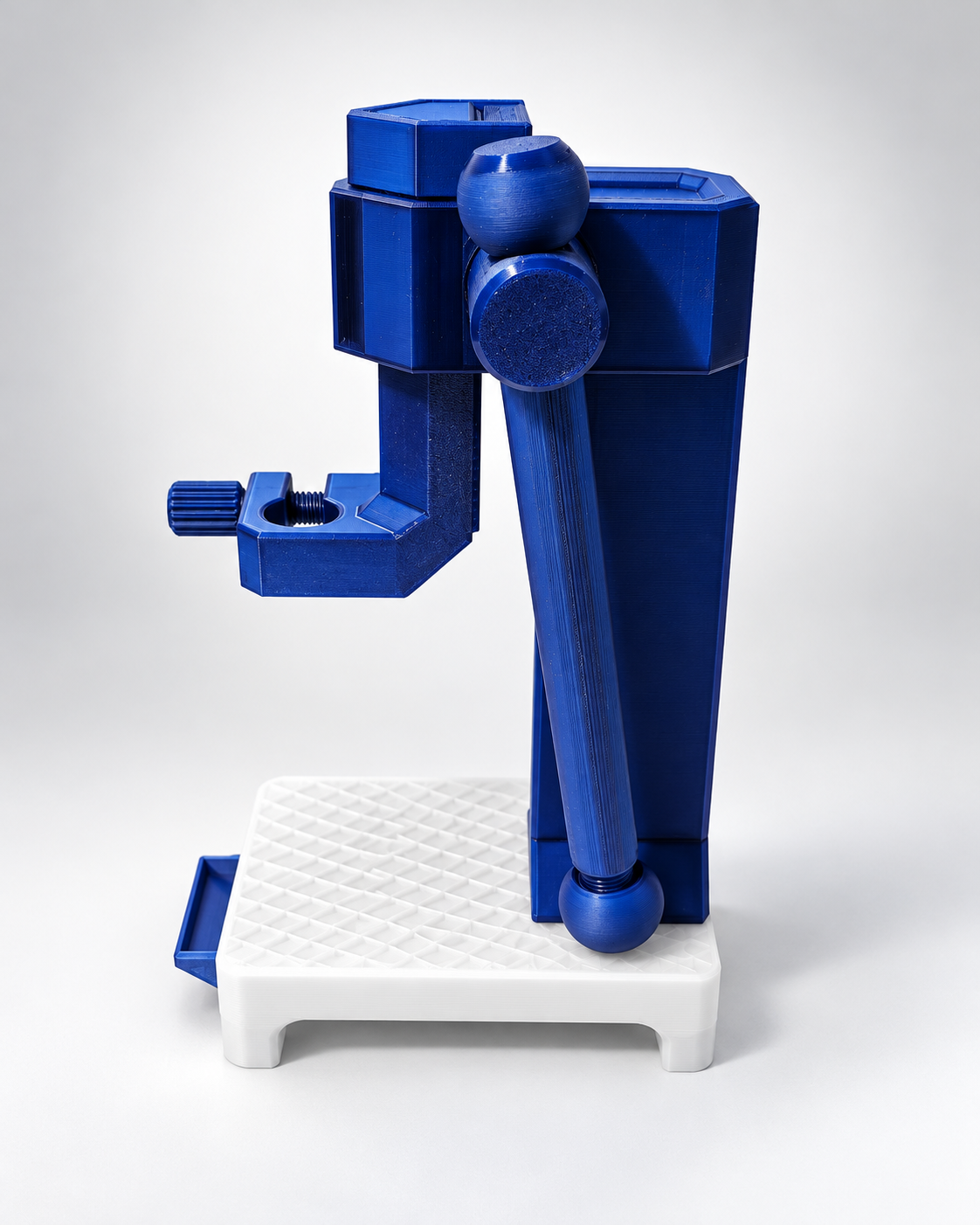
Real Relay example: this threaded-insert heat press is printed in PETG and used as a functional shop tool for controlled heat-set insert installation. It demonstrates PETG's usefulness for durable fixtures, tooling, and repeated handling.
Moisture resistance is useful. It is not the entire specification.
PETG is commonly selected for its resistance to moisture and many everyday chemicals, which makes it useful for functional parts around shops, labs, equipment, and general industrial environments. The exact chemical exposure still matters, and printed assemblies are not automatically sealed or pressure-tight.
Temperature is another important limit. PETG generally offers better heat capability than basic PLA, but applications with sustained elevated temperature may be better served by ABS, ASA, polycarbonate-class materials, or another engineering polymer.
Moisture
Useful for many humid, wet, or cleaning-adjacent applications, subject to geometry and assembly details.
Chemicals
Good general resistance does not mean universal compatibility. Identify cleaners, oils, solvents, or process chemicals when relevant.
Temperature
Include expected operating and peak temperatures when the part sits near motors, enclosures, lighting, or process equipment.
Outdoor Exposure
For prolonged UV and weather exposure, ASA is usually a more natural first material to evaluate.
Choosing PETG for a real project.
PETG covers a broad range of useful parts, but the grade, geometry, orientation, and operating environment still determine whether it is the right choice.
Is PETG good for functional 3D printed parts?
Yes. PETG is commonly used for brackets, guards, housings, fixtures, prototypes, utility components, and some low-volume end-use parts because it combines toughness, moisture resistance, and practical FDM processing.
Is PETG stronger than PLA?
“Stronger” depends on the property and geometry. PETG is generally tougher and less brittle, while PLA is typically stiffer. For working parts, impact, temperature, creep, layer direction, and the actual failure mode matter more than one strength number.
Should I choose PETG or ABS?
PETG is a strong choice when toughness, moisture resistance, and lower warping risk matter. ABS can be preferable for higher-temperature service, certain finishing requirements, or applications better matched to its mechanical behavior.
Can PETG be used outdoors?
It can work in some outdoor or semi-exposed applications depending on the grade and expected lifetime, but ASA is usually a better starting point for sustained UV and weather exposure.
Can PETG be used for low-volume production?
Yes, when FDM meets the dimensional, cosmetic, mechanical, and economic requirements. PETG is a practical option for repeat functional parts without mold tooling.
Can Relay help if I only know what the part needs to do?
Yes. Send the CAD and describe quantity, load, temperature, environment, critical interfaces, and target date. Relay can evaluate whether PETG is appropriate or recommend another material route.
Send the CAD and tell us how the part will actually be used.
Include quantity, loads, temperature, moisture or chemical exposure, critical dimensions, fasteners, finish requirements, and target date. Relay can review whether PETG is the right fit and quote the manufacturing route accordingly.